
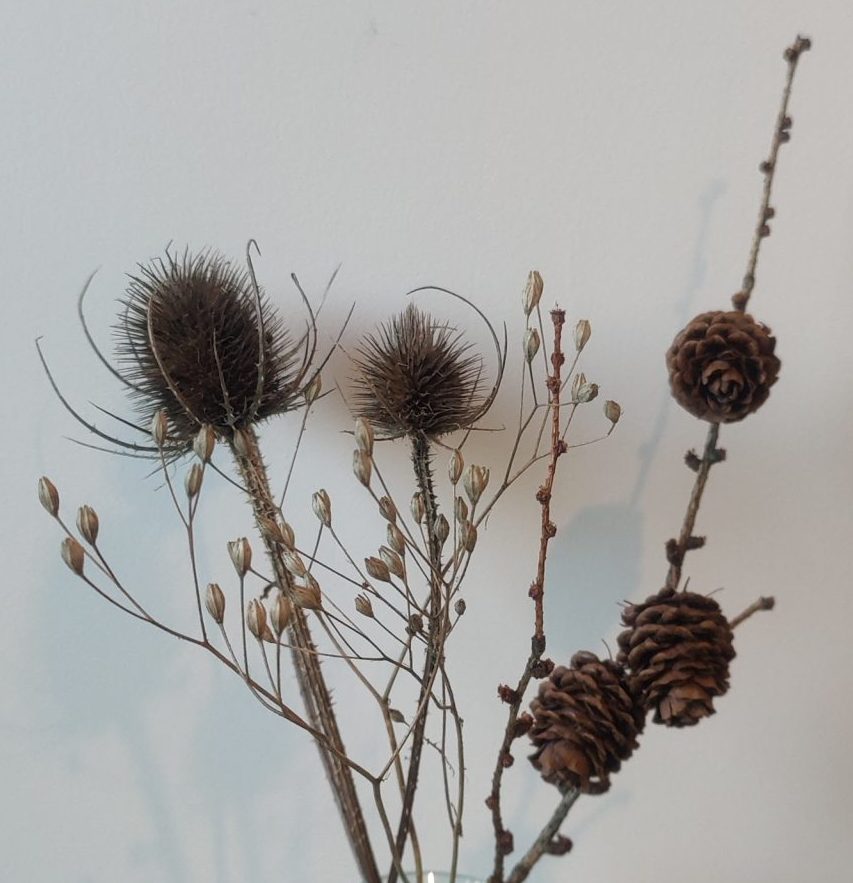
It’s been an unusually mild autumn so far and I’m still managing to find enough flowering stems to fill a small vase. But it’s only a matter of time before the first frosts will see off the last dahlias, and I’ll be forced to accept that the season of fresh green growth and bright colour is well and truly behind us.
As I work on planting plans for my own garden it’s a useful reminder to think about how the garden will look in the colder months. I’m less interested in finding plants that might bring unusual winter flowers – and more in finding ones that will hold the space with tall stems, elegant frames, finely constructed seed heads and subtle evergreens and greys.
Putting a collection of stems in a vase, at any time of year, is a wonderful way of looking more closely. In summer I notice how colours and shapes contrast and harmonise. In winter I look more closely at the beauty and range of sometimes extraordinary sculptural forms. I’m reminded of the Italian mathematician Fibonacci who must have done the same. It was Fibonacci who spread knowledge of the mathematical sequence where each number is made by adding together the previous 2 numbers (ie 1, 1, 2, 3, 5, 8, 13 etc) – a sequence that frequently occurs in nature’s spirals and is especially easy to see in pine cones. If you count the two sets of spirals that run down, both clockwise and anticlockwise, you’ll find 2 consecutive numbers on the Fibonacci sequence.
You don’t have to do the maths to know how extraordinary many seed heads are, which is why they make such lovely additions to seasonal wreaths and decorations. So before you clear away the remains of summer, look out for fading plants that might have more to offer. It’s good to leave some standing to provide food and shelter for the creatures in your garden, whilst others can be gathered to nourish you through the winter months.
If you’d like to learn how to make your own seasonal wreath from garden and foraged material please book on to one of the December workshops.


